
Higher education institutions are under increasing pressure to do more than manage the student lifecycle. They are being asked to grow partnerships, diversify revenue, support research and innovation, and create more connected experiences for external partners.
That shift requires a different way of thinking about Salesforce.
In Redpath’s webinar, Beyond the Student CRM: 5 Salesforce Trends Driving Higher Education Partnerships, Innovation, and Revenue, leaders from Georgia Southern University, the University at Buffalo, Salesforce, and Redpath discussed how institutions are using Salesforce to support cross-campus engagement, corporate partnerships, compliance, analytics, and AI.
The conversation centered on one core idea: technology alone does not create transformation. Institutions need technology, process, culture, and shared visibility moving together.
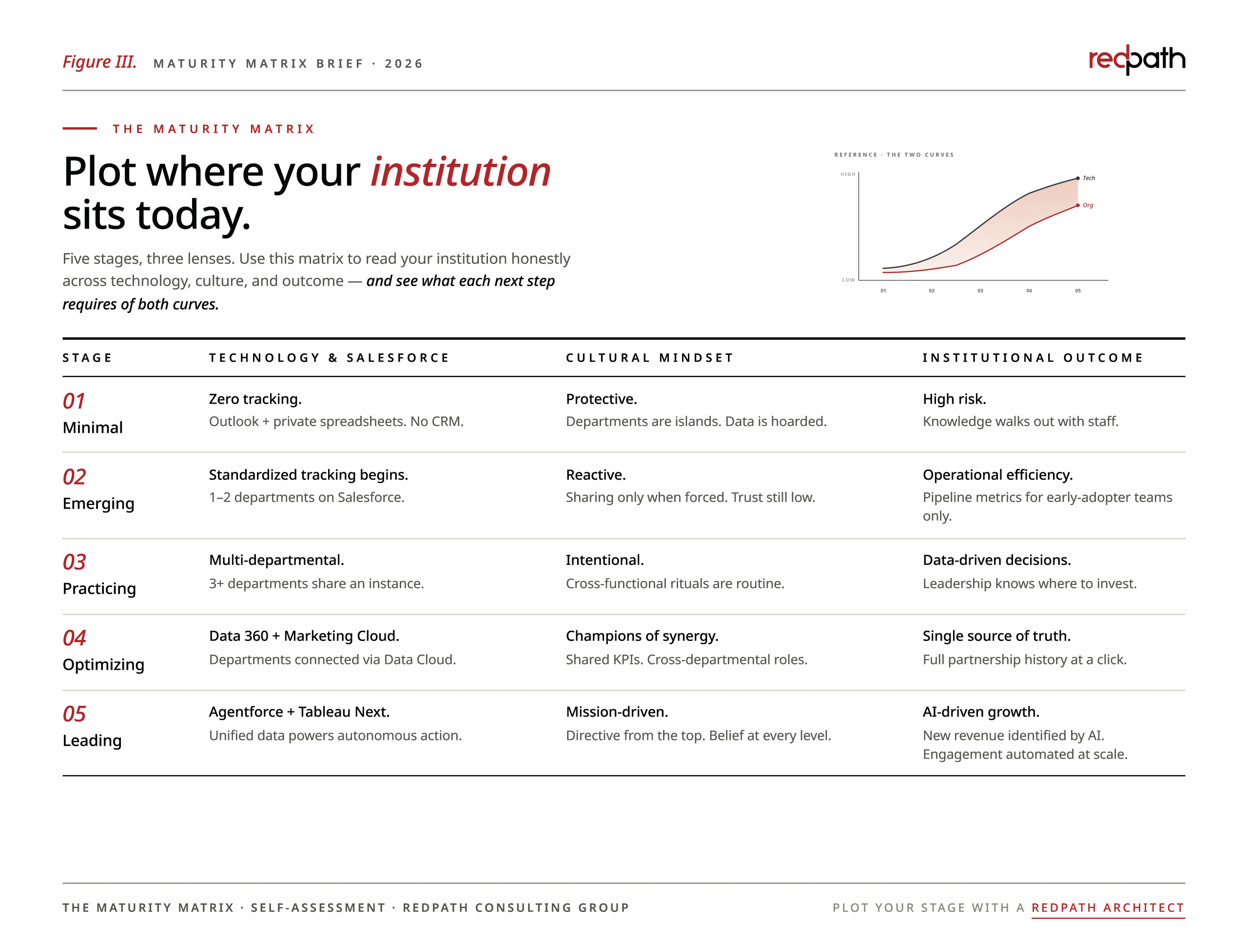
The Two-Curve Maturity Model
Jayne Corrigan-Monat, Redpath’s Vice President of Operations and Go-to-Market Strategy, opened the discussion with Redpath’s Two-Curve Maturity Model.
The model looks at two sides of institutional change:
- Technology maturity: systems, integrations, data, and platform capabilities
- Organizational maturity: people, process, culture, and readiness to work differently
Many institutions are ahead on one curve and behind on the other.
In some cases, technology is ahead of the organization. A system is implemented, but departments are protective of data, adoption is uneven, and teams continue to work in old patterns.
In other cases, the organization is ahead of the technology. Teams are ready to collaborate, leadership wants shared visibility, and staff understand the value of data, but the systems are still disconnected.
Either way, the result is the same: value is left on the table.
Jayne noted that this is especially important in areas like corporate engagement, research, and innovation, where relationships often span multiple units. When one person or one office “owns” a partner relationship, the institution risks losing that connection when someone changes roles. Or, just as often, a university walks into a partner meeting without realizing another unit is already working with the same company.
A stronger model requires institutions to understand where they are today, then define the next practical step forward.
Trend 1: Partner-Centric Engagement and Cross-Campus Alignment
The first major trend is the move toward partner-centric engagement.
Corporate engagement is no longer just about one office managing one relationship. At Georgia Southern University, John Stevenson, Associate Vice President for Business Engagement, described how his team was charged with creating more partnerships and external collaborations across philanthropy, research, experiential learning, and student opportunities.
Because the Office of Business Engagement was new, Georgia Southern intentionally started small. Rather than trying to align every division at once, they began within the Office of Business Engagement and gave other leaders visibility into what they were building.
That approach helped the university show, not just tell, the value of a shared system.
Career and Professional Development quickly became an early adopter, especially once the team saw the potential to integrate Handshake data and connect hiring activity to broader corporate relationships. Other units began logging in, reviewing company activity, requesting reports, and asking what Salesforce could look like for their own teams.
At the University at Buffalo, Tracy Krawczyk-Schiedel, Assistant Vice President for Communications, Marketing, and Digital Operations, described a more mature model. UB has more than 10 areas connected into its Salesforce approach across research, innovation, economic development, technology transfer, sponsored programs, entrepreneurship, and corporate engagement.
For UB, the goal is to make the university easier for partners to navigate. Rather than asking an external company to figure out the internal structure of the institution, UB is working to treat partners as customers of the whole university.
That partner-centric view allows teams to understand the full relationship, from internships and hiring to joint research, space usage, commercialization, and economic impact.
The takeaway: a shared view of the partner helps institutions coordinate outreach, avoid duplication, and tell a stronger story about impact.
Trend 2: Pipeline and Revenue Visibility
The second trend is the shift from counting activity to measuring outcomes.
John shared how Georgia Southern is using dashboards and reporting to understand what is actually happening in corporate engagement. Before Salesforce, leadership requests often required pulling together manual updates through documents, spreadsheets, or emails. Now, the team can refresh dashboards and share real-time information.
That visibility has changed the conversation.
Georgia Southern tracks both monetary and non-monetary partnerships. Monetary opportunities may include philanthropy, sponsored research, or sponsored internships. Non-monetary opportunities may include advisory board participation, speaking engagements, campus visits, executive visits, or research participation.
The important insight is that non-monetary engagement still matters. It builds relationships, strengthens trust, and can create a path toward future monetary opportunities.
John shared an early example from their data. In two quarters, Georgia Southern tracked 50 non-monetary collaborations. Seven converted into additional non-monetary opportunities, and four converted directly into monetary opportunities such as philanthropy, sponsored internships, or sponsored research. Three of those four came from on-campus visits.
The data is still early, but it is already helping the team understand which engagement types may be most valuable and where to focus next.
The takeaway: when institutions can see both activity and outcomes, they can move beyond anecdotes and make more strategic decisions.
Trend 3: Compliance and Process Rigor
The third trend is the growing importance of compliance and process rigor.
As universities expand external partnerships, research agreements, and revenue-generating collaborations, compliance requirements are becoming more complex. Tracy emphasized that technology cannot fix unclear processes.
At UB, the team is working through a centralized research compliance model. The lesson from their earlier Salesforce work with Redpath was clear: the breakthrough was not just a feature. It was getting departments aligned on shared opportunity stages, handoffs, and processes, then building the system around that agreement.
That same principle applies to compliance.
If roles, steps, and ownership are not clear, technology can reinforce confusion rather than solve it. Tracy described the goal as aligning people and processes first so that technology can support the right workflow.
John shared a similar lesson from Georgia Southern. In the first rollout, his team intentionally avoided some complex compliance processes to keep the implementation manageable. Looking back, he believes the team may have been more ready for process rigor than expected, especially in areas like sponsored research and partner vetting.
The takeaway: institutions should avoid automating unclear processes. Process agreement and ownership must come first.
Trend 4: Analytics and Observability
Ryan Frazee from Salesforce framed observability around a familiar idea: what gets measured gets managed.
KPIs show the outcomes an institution wants to drive. Observability shows the steps along the way. As more tasks become automated, institutions need the ability to see what is happening inside the process, not just the final result.
Ryan described it as moving from “trust me” to “trust and verify.” Leaders need to be able to see where an engagement is moving, where it is stalled, and what actions are happening along the path.
Tracy shared how UB keeps this actionable by making dashboards deliberately simple. Their dashboards use big numbers and clear color indicators: green when performance is ahead, yellow when it is close, and red when it is behind.
That simplicity matters. Users should not need to run a report or email someone to understand performance. The information should be visible, clear, and actionable.
The takeaway: good analytics should help teams make decisions quickly, not add another layer of complexity.
Trend 5: AI-Augmented Execution
The fifth trend is AI, but not AI for its own sake.
Tracy described how UB is applying AI to improve the external partner experience. The university is working to make its website function less like a brochure and more like a front door.
Instead of forcing partners to navigate internal university language and structures, UB wants visitors to self-identify and describe what they need in their own words. An AI agent can interpret intent, answer common questions, and route visitors to the right area of focus, whether that is talent, research collaboration, intellectual property, or funding.
This helps reduce friction for partners and creates a more structured intake channel for internal teams.
The goal is not to remove traditional ways of contacting the university. It is to respect the partner’s time and make it easier to get to the right conversation.
The takeaway: AI should help teams and partners move faster by reducing friction, surfacing insights, and supporting better routing.
Getting Started in a Decentralized Institution
During the Q&A, one attendee asked how large, decentralized institutions can get initial buy-in.
John’s advice from Georgia Southern was to start small and create visibility. Instead of waiting for full consensus across the institution, his team built within their division and gave other leaders access. That allowed others to see the model, ask questions, and imagine how Salesforce could apply to their own work.
Tracy shared that UB’s approach was helped by a new organizational structure, strong revenue focus, and leaders who valued customer service for both internal and external audiences. UB also made shared data part of the culture, reinforcing the idea that the data belonged to everyone.
Both examples point to the same principle: start where there is readiness, create value, and use that value to expand.
The Larger Shift
The conversation made one thing clear: higher education is moving beyond the student CRM.
Salesforce is increasingly being used to support broader institutional strategies, including corporate engagement, research administration, innovation, advancement, workforce development, and external partnerships.
But the institutions seeing the most value are not simply implementing technology. They are aligning systems with culture, process, and governance.
The path forward is not always campus-wide transformation on day one. It may begin with one office, one use case, or one shared dashboard. What matters is creating a foundation that helps the institution see relationships clearly, coordinate work across units, and measure impact over time.
For universities looking to grow partnerships, strengthen revenue visibility, and support innovation, the next step is not just adopting a tool. It is building a model that technology and people can sustain together.